| Client | Abu Dhabi National Oil Company (ADNOC) |
| Project | Hail & Ghasha Full Potential Development – Assess Study |
| Sector | Energy, Chemicals & Resources |
| Services | FEL1 Business Planning & Feasibility |
| Location | United Arab Emirates |
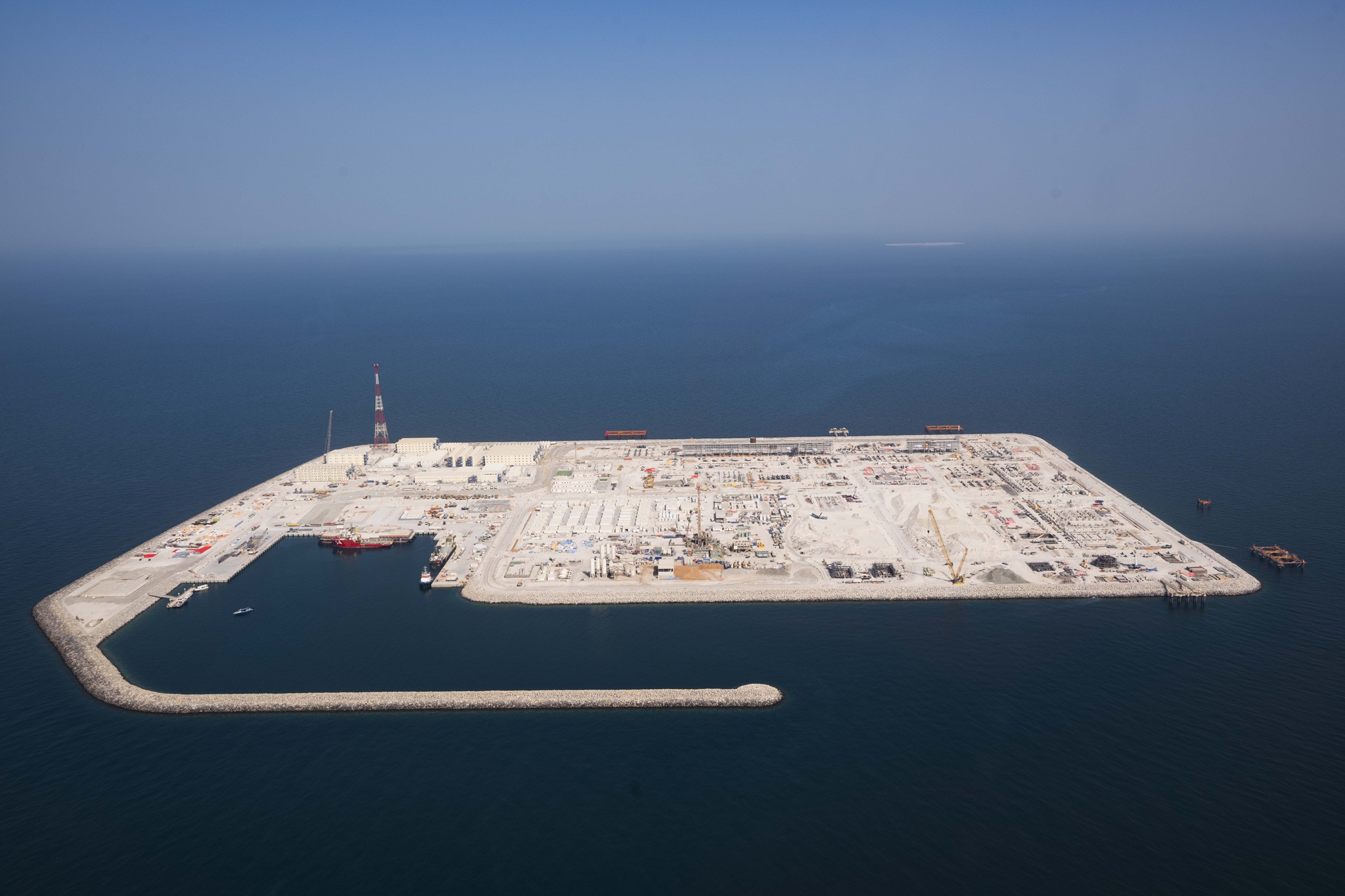
image courtesy of ADNOC.
Objective
ADNOC engaged io to conduct an ASSESS Stage study for the Hail & Ghasha Full Potential Development (HGFPD), building on the ongoing HGD project (in EPC, with start-up Q1 2028). The study evaluated development options for Ghasha West and infill production from Ghasha East and Hail (~1 Bcfd raw gas), together with four Future Growth Fields (Shuweihat, Hair Dalma, Hail Khuff, Mubarraz) offering a further ~0.5 Bcfd. The fields are located within the UNESCO recognised Marawah Marine Biosphere Reserve, producing ultra-sour gas (H₂S up to 35%), an exceptionally complex technical and environmental setting.
The study objective was to identify the optimal development pathway, maximise long-term value from ADNOC’s offshore gas resources and define a clear route into SELECT, supporting production start-up between 2032 and 2035.
Project Scope
io led the ASSESS Study using its Decision Quality (DQ) methodology, evaluating both the HGFPD Base Scope and Future Growth Fields to identify the highest-value development pathway:
- Framing Workshop: established key value drivers (economics, schedule, licence to operate, technical robustness) and agreed the Opportunity Statement
- Options Identification: developed a Mutually Exclusive, Collectively Exhaustive (MECE) catalogue of four bookend concepts (Technically Robust; Maximum HGD Integration; Minimum Environmental Impact; Best FPD Schedule) plus three Future Growth Field concepts
- Side Studies: targeted investigations covering Early Production Scheme, Artificial Lift philosophy, HGD infrastructure adequacy, AGRU technology selection, and Sulphur granulation plant siting
- Techno-Economic Evaluation: all seven concepts assessed against value drivers using comparative analysis and building block decomposition to identify key value levers
- Hybrid Concept Formulation: two hybrid concepts combining the most attractive features of all four bookend concepts, followed by OPP2 right-sizing analysis
- DQ Scoring: formal Decision Quality assessment evidencing study quality at close-out
Findings & Recommendations
Findings
- Hybrid concepts deliver substantial value uplift: Minimum CAPEX Hybrid and Managed Risk Hybrid outperform the Technically Robust baseline by $3.5–4.1bn NPV
- Wellhead towers and platforms preferred over artificial islands for Ghasha West – more attractive on CAPEX, schedule and environmental footprint
- Minimum offshore processing (free-flow wet gas to shore) is technically viable and economically superior to full offshore processing
- Brownfield integration of Ghasha East infill with HGD Phase 1 drill centres offers ~$417M CAPEX saving, subject to SIMOPS risk de-risking in SELECT
- Right-sizing OPP2 from 930 to 600 MMscfd reduces CAPEX by ~$3bn, improving NPV by $0.8bn and IRR by 1.2%
- Future Growth Fields add most value as phased plateau extensions post-2038; Shuweihat identified as highest-value individual field, adding ~$500M NPV
Recommendations
- Carry both Hybrid concepts into SELECT as front-runners; Hybrid 1 (Minimum CAPEX, 600 MMscfd OPP2) as primary front-runner targeting FID 2031 / RFSU 2035
- Adopt a phased base scope development strategy (“West then East” or “High Value Clusters”) to prioritise early liquids production
- Phase Future Growth Fields as plateau extensions post-2038, starting with Shuweihat
- Focus SELECT on: pipeline sizing and production deliverability; Ghasha East infill constructability/SIMOPS assessment; AGRU licensor selection; and long-lead item procurement
io Value Add
io enabled ADNOC to make confident, value-driven decisions within one of the most technically and environmentally challenging offshore developments in the region, identifying more than $4bn of potential NPV uplift relative to the starting concept:
- Decision Quality Leadership: Applied io’s proprietary DQ framework from Framing Workshop through to formal DQ Scoring at close-out, ensuring every decision was structured, transparent and evidence-based. All stakeholders were aligned on value drivers, study boundaries and concept catalogue before technical work commenced, eliminating rework and enabling efficient progression to SELECT.
- $4bn+ NPV Uplift Identified: Through systematic building block decomposition and concept comparison, io identified ~$3.6bn of CAPEX reduction between the Technically Robust baseline and the preferred Managed Risk Hybrid, and a further ~$3bn through OPP2 right-sizing, translating into over $4bn of NPV improvement.
- Technical Depth in an Exceptionally Complex Environment: Delivered rigorous techno-economic analysis across ultra-sour offshore gas development (H₂S up to 35%), a UNESCO protected marine setting, and active brownfield integration with a major project in EPC, a combination of constraints that demands deep multi-discipline expertise across subsurface, offshore, onshore processing, flow assurance, environmental and economics.
- Stakeholder Alignment Across a Complex Organisation: Facilitated structured Framing and Brainstorming workshops and decision review sessions with ADNOC’s technical, commercial and operational teams, securing alignment on concepts, trade-offs and study outcomes, and building the confidence needed to move decisively from ASSESS to SELECT.
- Clear Path to FID: Delivered a well defined SELECT stage roadmap with front-runner hybrid concepts, a right-sized development frame, identified critical uncertainties, and a prioritised study programme, giving ADNOC a structured, de-risked pathway from ASSESS through SELECT to FID.
Through a structured Decision Quality-led ASSESS study, io enabled ADNOC to navigate one of the world’s most complex offshore gas developments with confidence and clarity. By evaluating multiple development pathways, challenging conventional assumptions and systematically identifying value drivers, io uncovered more than $4bn of potential NPV uplift while reducing execution risk and environmental impact.
The outcome was a robust, evidence-based roadmap into SELECT, providing ADNOC with the certainty, alignment and strategic direction required to progress towards FID and future production growth.