| Client | UK Department of Transport / Carbon Neutral Fuels |
| Project | Project Starling (ASAP-DAC) PreFEED |
| Sector | Energy, Chemicals & Resources |
| Services | FEL2 – Concept Select & Definition |
| Location | United Kingdom |
Objective
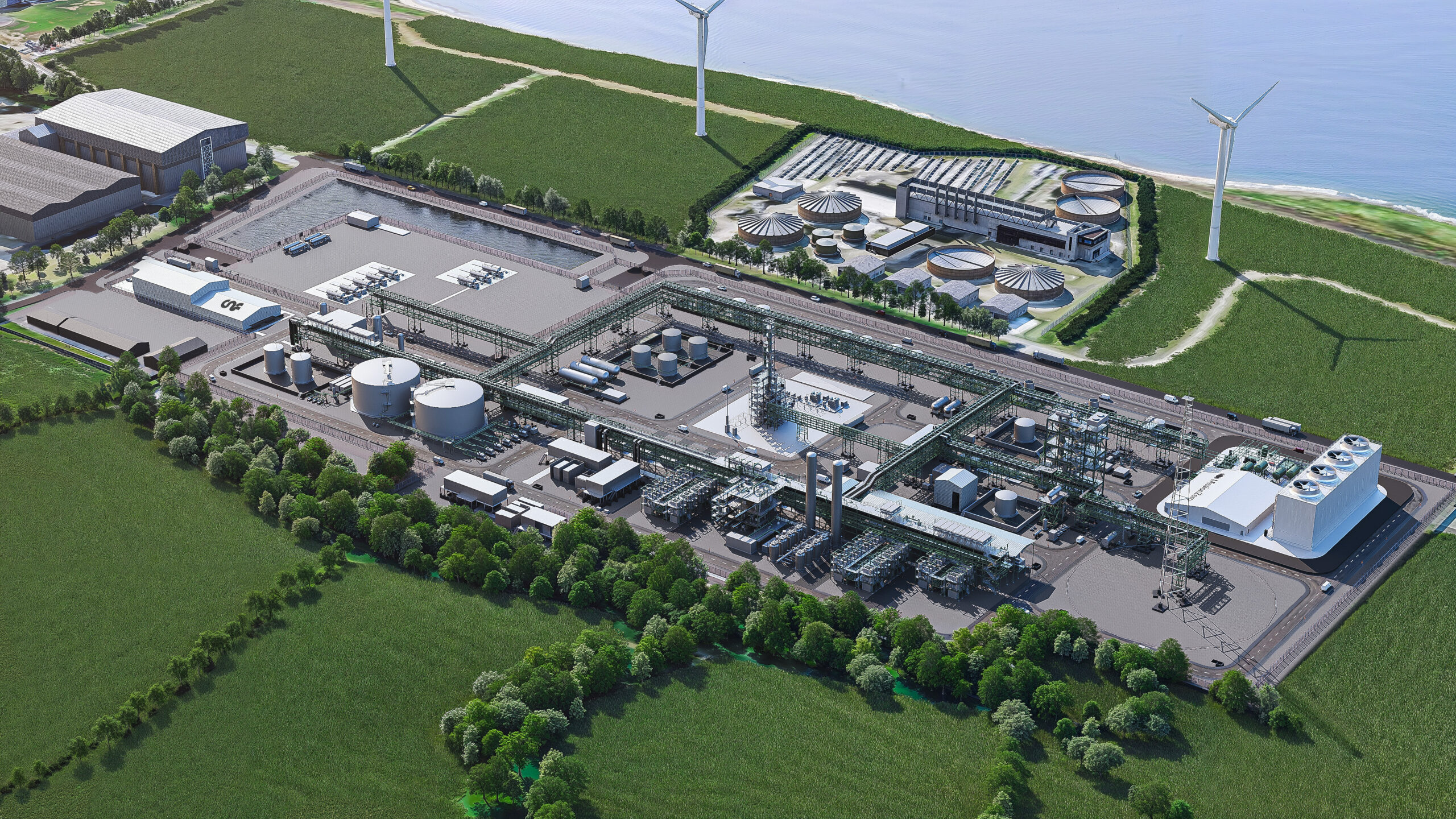
Carbon Neutral Fuels (CNF), in partnership with io consulting and Mission Zero Technologies, progressed the technical and commercial development of its first commercial-scale Power-to-Liquids (PtL) Sustainable Aviation Fuel (SAF) facility through the UK Advanced Fuels Fund. The project, Advancing Sustainable Aviation via Power-to-Liquid & Direct Air Capture (ASAP-DAC), now known as Project Starling, represents CNF’s first-of-a-kind deployment aimed at establishing scalable e-SAF production in the UK.
The PreFEED (FEL 2) sought to:
- Increase technical definition of key process units
- Confirm technology selections
- Improve system integration and operability
- Refine cost and economic modelling
- Position the project for FEED and future investment
The overarching objective was to demonstrate that a UK-based e-SAF facility could be technically robust and commercially credible under the SAF Mandate framework.
Project Scope
The Project Starling facility is designed as an integrated Power-to-Liquids system, combining carbon dioxide capture and import, high-temperature electrolysis to produce hydrogen and carbon monoxide, Fischer-Tropsch (FT) synthesis to generate liquid hydrocarbons, and upgrading to produce Sustainable Aviation Fuel (SAF). The configuration requires tight integration between electrolysis, heat recovery, utilities, logistics infrastructure and policy-driven revenue mechanisms.
FEL 2 progressed the project from concept-level definition to preFEED maturity through:
- Feasibility studies for the syngas plant (including parallel CO₂ and H₂O electrolysis), FT synthesis unit and product upgrading facilities.
- Validation of electrolyser technology selection and optimisation of heat integration between exothermic FT reactions and electrolysis steam demand.
- CO₂ import strategy development, assessing pipeline, road, rail and marine options, and their implications for storage, purity and infrastructure.
- Dynamic system modelling to evaluate operating philosophies, electricity sourcing strategies and plant turndown scenarios.
- Refinement of the capital cost estimate and development of an updated economic model incorporating policy-driven certificate revenues and electricity price sensitivities.
- Early-stage HAZID and ENVID studies to identify major process, operational and environmental risks ahead of FEED.
Overall, the scope focused on strengthening technical certainty, integrating detailed licensor data into a coherent whole-system design, reducing integration risk, and improving confidence in long-term economic performance prior to entering FEED.
Findings & Recommendations
Technical Insights
- SOEC electrolysis integrated with FT heat recovery is the preferred configuration, improving overall system efficiency.
- High-quality syngas from parallel electrolysis enhances downstream conversion performance.
- Integration of detailed licensor data improved SAF yield and reduced net power demand compared to earlier phases.
- A ~25 ktpa SAF facility represents an appropriate first commercial scale, balancing efficiency and delivery risk.
- CO₂ logistics strategy is site-dependent and materially influences infrastructure design.
Economic Considerations
- Electricity pricing is the dominant driver of project economics.
- Certificate value under the SAF Mandate materially impacts viability.
- Levelised Cost of Certificates is a more meaningful metric than Levelised Cost of SAF for mandate-driven projects because the number of certificates awarded varies with the carbon intensity of the fuel produced.
- Under updated electricity and market assumptions, project returns are highly sensitive to power cost and CO₂ pricing.
- PPA strategy could be optimised to reflect operational flexibility but only where it delivers measurable value.
io Value Add
io ensured that technical optimisation and commercial realism progressed in parallel, materially reducing development risk ahead of FEED by:
- Applying a disciplined decision-quality framework to technology and licensor selection.
- Architecting a fully integrated, end-to-end system rather than optimising process units in isolation.
- Developing dynamic technical and economic models aligned to the SAF Mandate and certificate-based revenue mechanisms.
- Isolating electricity cost and procurement strategy as the critical value lever, enabling targeted strategic focus.
FEL 2 materially improved the technical definition and performance of the Project Starling facility while clarifying the economic realities of UK-based e-SAF production.
Technical efficiency increased and integration risks reduced. However, long-term viability remains strongly linked to electricity pricing and policy stability.
Through disciplined Front End Loading and system-level integration, io positioned CNF to enter FEED with clearer priorities, reduced uncertainty and a stronger foundation for investment.