| Client | Abraxas Power Corporation |
| Project | Hydrotreated Vegetable Oil (HVO/HEFA) SAF PreFEED |
| Sector | Energy, Chemicals & Resources |
| Services | FEL 2 – Concept Select & Definition |
| Location | Romania |
Objective
To deliver a PreFEED study for an integrated, industrial-scale Hydrotreated Vegetable Oil (HVO) Sustainable Aviation Fuel (SAF) facility in Romania, converting Camelina seed into SAF via the Hydroprocessed Esters and Fatty Acids – Synthetic Paraffinic Kerosene (HEFA-SPK) pathway. The study aimed to:
- Establish the technical requirements for a greenfield, co-located development.
- Define project boundaries and work packages.
- Develop process simulation and design deliverables.
- Produce a Class IV CAPEX estimate.
- Assess carbon intensity in line with RED III requirements.
- Support an application for €93 million funding from the EU Modernisation Fund.
The development is intended to contribute to the decarbonisation of the European aviation sector.
Project Scope
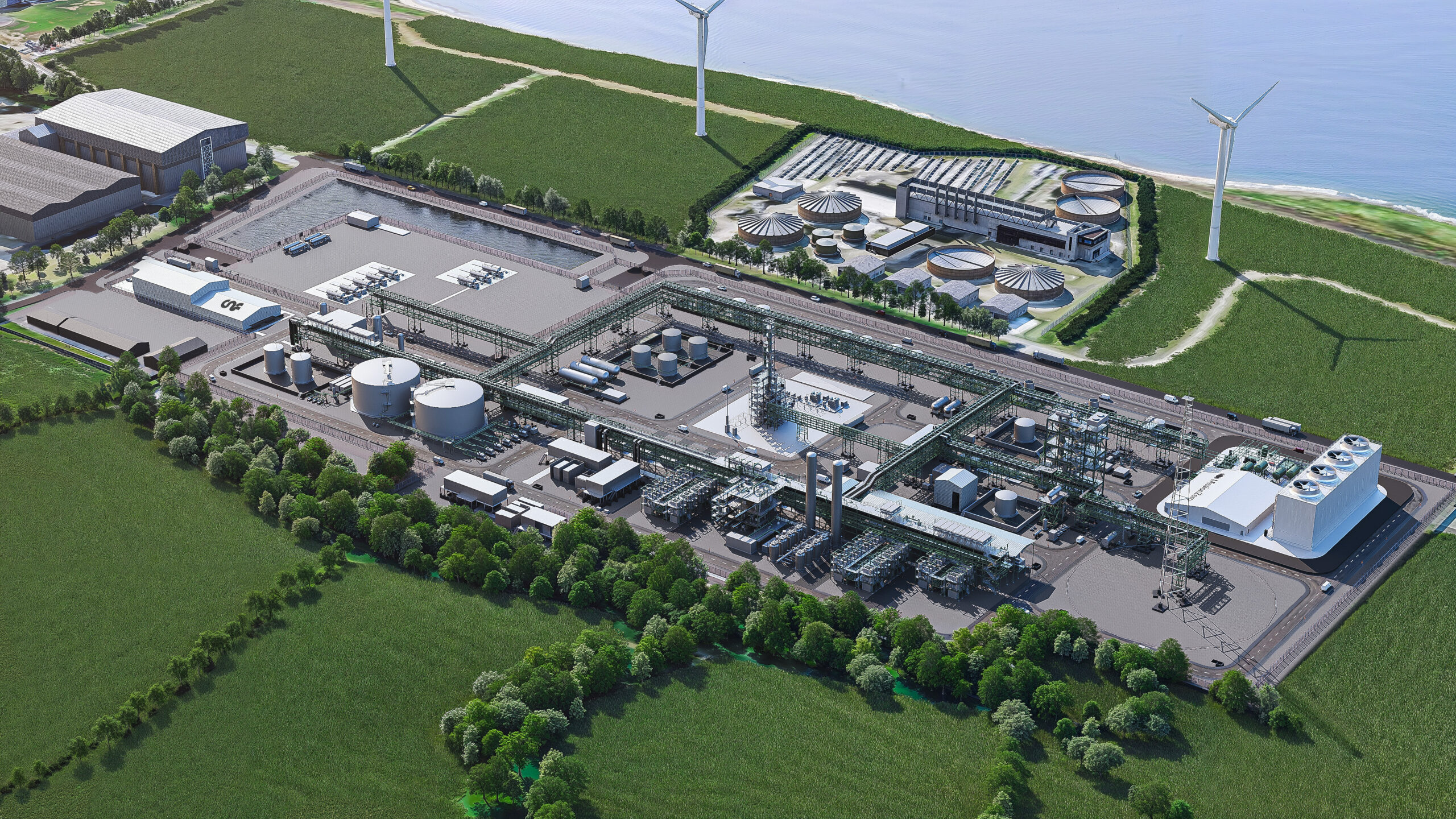
The PreFEED covered an integrated development at a greenfield site in Romania.
Integrated Facilities
The project comprises:
- Camelina Seed Pre-Treatment and Pressing Facility
- Pre-cleaning, flattening, moisture and heat treatment.
- Mechanical oil extraction.
- Solvent Extraction Plant
- Additional oil extraction from pressed cake.
- Production of meal as a by-product.
- Camelina Oil Refinery
- Degumming, neutralisation and bleaching.
- Production of refined Camelina oil suitable for SAF conversion.
- SAF Production Facility (HEFA-SPK Route)
- Hydrogen generation via electrolysis.
- Hydrotreating.
- Isomerisation / hydrocracking.
- Hydrogen recovery.
- Distillation to produce SAF, HVO diesel and naphtha.
- Utilities and Infrastructure
- Electrical substation and grid connection.
- Water supply from the Danube.
- Effluent and wastewater treatment.
- Storage and export systems.
- Flare, firewater and supporting utilities.
Design Basis & Capacity
The updated basis targeted:
- ~3,600 tpd Camelina seed.
- ~50 t/h refined Camelina oil feed to SAF production.
- SAF production of ~22.6 t/h (~180 ktpa).
- HVO diesel production of ~19.5 t/h (~156 ktpa).
- Overall plant power demand of ~153 MW (End of Life basis).
The facility is designed to operate in base case mixed product mode or in maximum SAF or maximum HVO modes.
Findings & Recommendations
Findings
Integrated Technical Concept Defined
Complete PreFEED technical package, including:
- In-house HYSYS simulation of the SAF Production Facility.
- 84% overall conversion of Camelina oil to SAF and HVO diesel.
- Flexible product slate capability (SAF/HVO ratio adjustable).
- Identified energy penalty when operating in maximum SAF mode due to additional hydrocracking.
Carbon Intensity Compliance Achieved
Using RED III Annex V methodology:
- Calculated CI: 23.85 gCO₂e/MJ
- RED III target: ≤ 32.9 gCO₂e/MJ
- Calculated reduction vs fossil comparator: 74.6%
The project meets the RED III requirement of at least 65% emissions reduction.
Seed yield was identified as the dominant driver of lifecycle emissions (eec component).
Capital Cost Structure Established
Two concepts were evaluated:
- Core facility.
- Facility plus port and train storage infrastructure.
The estimate was prepared in accordance with AACEi Class 4 methodology (±40% accuracy). The hydrogen plant, SAF production facility and utilities represent the largest cost blocks.
Value Improvement Opportunities Identified
A structured review identified potential cost reduction measures, including:
- Reduction of refined oil, product and feedwater storage capacity.
- Cost optimisation by using alternative hydrogen generation technologies and impact on Carbon Intensity
- Firewater demand reduction via tank segregation.
- Conveyor system length optimisation.
- Removal of potable water system (if tie-in feasible).
Collectively, these measures could reduce expected project cost by approximately 6.4% (Concept 2 basis).
Logistics and Infrastructure are Critical Risk Areas
The feasibility of the project is strongly dependent on:
- Availability of sufficient agricultural land.
- Seed storage and transport capability (road, rail and barge).
- Port and train station storage capacity.
- Power supply constraints and green PPA availability.
- Raw water extraction permitting from the Danube.
- Final SAF licensor selection and vendor engagement.
Economic Sensitivity to Market Variables
The economics model identified exposure to:
- Meal monetisation risk.
- Diesel sales price volatility.
- Camelina seed feedstock price.
- Grid power pricing.
- Capital cost escalation.
Upside cases show improved performance under stronger pricing or reduced capital cost conditions.
Recommendations
Confirm Optimal Production Strategy
- Reassess optimal throughput and product slate based on refined logistics data and economics.
- Confirm whether base case mixed production or maximum SAF mode provides strongest long-term position.
Advance Seed Supply and Logistics Definition
- Confirm land availability and realistic seed yield assumptions.
- Validate storage and transport capacity at farm, port and rail nodes.
- Perform detailed logistics study in next phase.
Progress Licensor Engagement
- Continue engagement with Honeywell-UOP.
- Engage additional licensors (e.g. Axens).
- Perform paid technical studies to firm up scope and guarantees.
- Select licensor prior to FEED.
Refine Carbon Intensity Model
- Update CI model at next engineering stage.
- Incorporate confirmed farm locations and transport routes.
- Refine seed yield assumptions and logistics emissions.
Confirm Utilities and Infrastructure
- Confirm grid capacity and green PPA feasibility.
- Confirm raw water permitting and pump house suitability.
- Develop detailed port and rail infrastructure definition.
- Confirm export routing strategy.
Optimise Plot Plan and Storage Strategy
- Perform detailed plot plan optimisation to reduce footprint.
- Evaluate storage reduction scenarios against operational flexibility.
- Validate firewater demand reduction strategy.
io Value Add
The PreFEED demonstrates io’s capability to:
- Integrate agricultural supply chain considerations with refinery-scale process design.
- Develop in-house process simulation aligned with licensor data.
- Translate mass balance outputs into carbon intensity modelling compliant with RED III.
- Deliver structured cost estimation and value improvement analysis.
- Provide scenario-based economics modelling to inform optimal production strategy.
- Identify and clearly articulate technical, logistical and commercial risks ahead of FEED.
Importantly, the study provides Abraxas with:
- A technically defined greenfield concept.
- Evidence of RED III compliance.
- Defined infrastructure requirements.
- A structured roadmap to FEED, FID and projected start-up (Q3 2030).
The Abraxas Romania HVO SAF PreFEED establishes a technically viable, RED III-compliant integrated Camelina-to-SAF facility with flexible product configuration and a defined development pathway.
While further work is required in feedstock logistics, licensor selection, infrastructure definition and optimisation, the study provides a comprehensive foundation to progress into FEED and advance funding discussions.