| Client | Carbon Neutral Fuels / UK Department for Transport |
| Project | Project Starling (ASAP-DAC) FEL 3a FEED |
| Sector | Energy, Chemicals & Resources |
| Services | FEL 3 – FEED |
| Location | United Kingdom |
Objective
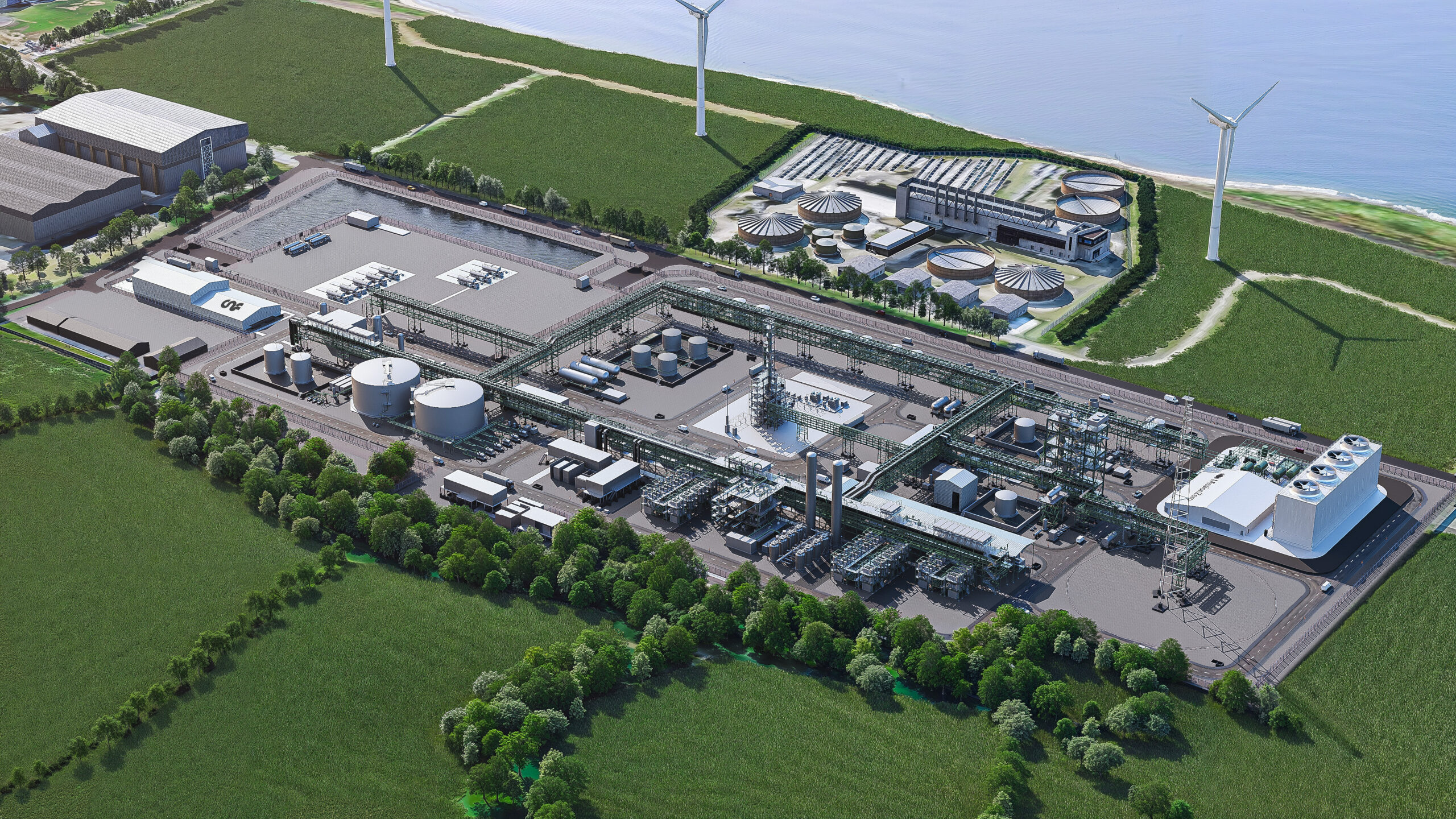
To deliver the Front-End Engineering Design (FEL 3a / FEED) for a first-of-a-kind commercial-scale e-SAF facility as part of the UK Advanced Fuels Fund, funded by the Department for Transport, the Advancing Sustainable Aviation via Power-to-Liquid & Direct Air Capture (ASAP-DAC). The project from concept definition to a fully integrated FEED-level design, providing a credible pathway to project sanction and execution.
The plant integrates Direct Air Capture (DAC) of CO₂, Solid Oxide Electrolysis (SOEC) & Fischer-Tropsch synthesis to produce Sustainable Aviation Fuel (SAF) from a combination of biogenic and atmospheric CO₂, water and renewable power.
The FEL 3a phase was undertaken to mature the project from concept definition into a fully integrated FEED-level design, providing the engineering definition, cost certainty and execution readiness required to support progression into FEL 3b and Final Investment Decision (FID).
Project Scope
io consulting led the multidisciplinary FEED (FEL3A) engineering scope, covering full system integration and design maturation across all core disciplines. This included:
- Delivery of a fully integrated FEED across process, mechanical, piping, civil, structural, electrical, instrumentation, telecoms, HVAC, environmental, safety, cost and schedule disciplines.
- Integrated four novel licensor processes, Topsoe SOEC electrolyser, Johnson Matthey Fischer-Tropsch synthesis, Honeywell UOP Fischer-Tropsch upgrading & Mission Zero DAC, into a single, executable design.
- Developed core engineering deliverables including process simulations, PFDs, P&IDs, equipment & package specifications, plot plan, 3D model & full design dossiers across all disciplines.
- Execution of critical safety, risk and operability studies including HAZID, HAZOP, LOPA, SIL, ENVID, FERA, QRA and RAM assessments.
- Completion of 45% and 90% model reviews to validate operability, maintainability and constructability.
- Development of construction, commissioning and operational readiness strategies.
- Preparation of Class 3 cost estimate methodology, Level 2 execution schedule and FEL 3b transition planning.
- Environmental and permitting support through air dispersion modelling, noise studies and preliminary environmental assessments.
The project required intensive interface management between licensors, stakeholders and funding partners, ensuring alignment across a rapidly evolving first-of-a-kind development while maintaining design integrity and delivery momentum.
Key Execution Metrics and Outcomes
Key Execution Metrics
- Total Duration: 9 months
- Total Number of Deliverables: 250+ multi-discipline documents
- Full Time Equivalents (at peak): ~35 FTE at peak (avg ~18 FTE )
- Weekly Progress Achieved (at peak): 6.2%
- Client Management: Co-located client engagement at io London with weekly progress reviews and workshops
Outcomes
- Integrated, buildable plant definition established: The FEL 3a phase transformed a complex Power-to-Liquid concept into a fully integrated facility design, combining DAC, SOEC, Fischer-Tropsch synthesis and upgrading technologies into a coherent and executable configuration. This established a clear and aligned Basis of Design across all disciplines.
- Technology integration de-risked: Multiple licensor packages were successfully integrated into the Balance of Plant design, resolving critical interface challenges and defining system boundaries, utility requirements and operating philosophies. This significantly reduced the uncertainty typically associated with multi-licensor developments.
- Design maturity advanced to support investment decisions: Engineering development progressed to a level capable of supporting a Class 3 cost estimate, execution planning and FEL 3b readiness assessment, providing stakeholders with increased confidence in project viability and delivery strategy.
Outcomes (cont…)
- Safety and operability embedded into the design: Comprehensive HAZID, HAZOP, LOPA, SIL, ENVID, FERA and QRA studies informed facility layout, process design and control philosophy development. Major accident hazards, operability constraints and environmental risks were identified and mitigated early in the project lifecycle.
- Robust control and shutdown philosophy defined: An integrated control and safety system architecture was established, defining how the facility will be operated, protected and safely shut down under both normal and abnormal operating conditions.
- Constructability and execution strategy validated: Through model reviews, constructability assessments and value engineering workshops, the design was progressively refined to improve buildability, maintainability, modularisation opportunities and commissioning efficiency.
- Project risks actively managed and reduced: Key challenges associated with licensor alignment, evolving design inputs, funding constraints and information gaps were managed through structured governance processes, including risk registers, decision registers and technical query management. This created a transparent audit trail and reduced execution risk.
- Clear pathway to FEL 3b and FID established: The FEL 3a outputs provided a robust engineering foundation for progression into FEL 3b, with defined scope, interfaces, residual risks and execution planning requirements supporting a controlled transition towards Final Investment Decision.
io Value Add
io acted as the Project Architect and System Integrator, ensuring that a highly complex first-of-a-kind e-SAF development was translated into a coherent, executable and investment-ready design.
- End-to-end integration: Unified four novel licensor technologies into a single operable facility design, bridging technical, commercial and organisational interfaces across the programme.
- Decision Quality and Governance: Applied disciplined decision-making processes through structured governance, risk management and technical assurance frameworks, maintaining project control despite evolving information and schedule pressures.
- Design maturity acceleration: Rapidly advanced engineering maturity to support Class 3 cost estimating, execution planning and future investment decisions.
- Stakeholder alignment: Facilitated collaboration across CNF, technology licensors, funding bodies and project stakeholders, maintaining momentum and confidence throughout the FEED phase.
- Risk-managed delivery: Enabled the project to progress through critical development milestones while preserving long-term technical integrity, commercial viability and execution certainty.
By delivering a coherent and integrated FE 3a package, io established the engineering, cost and execution foundations required for Carbon Neutral Fuels to progress one of the UK’s most ambitious commercial-scale e-SAF developments towards FEL 3b, Final Investment Decision and future deployment.